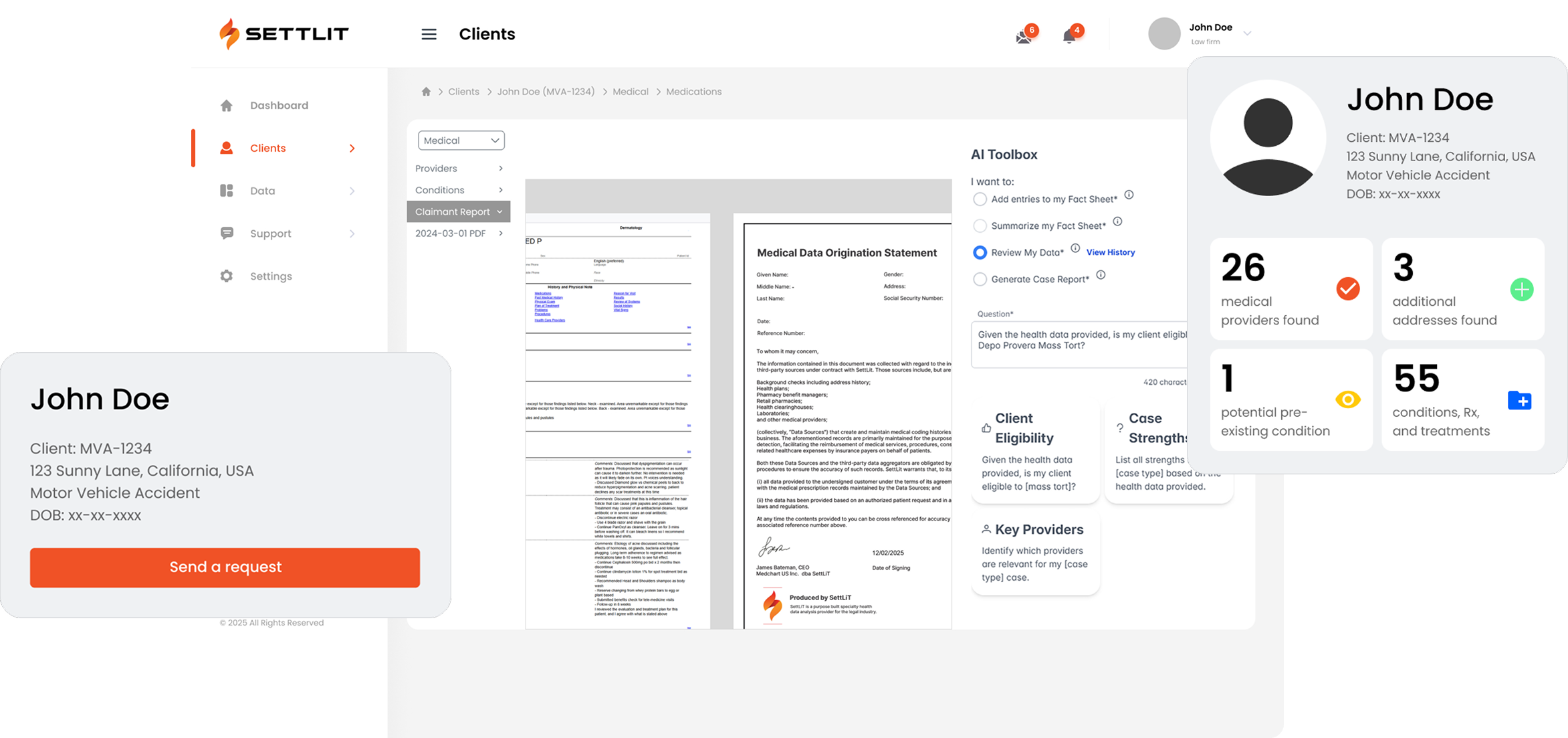
.png)
Mesothelioma Moves Fast. Your Medical Intelligence Should Too.
Surface diagnosis, treatment history, and provider networks before you commit to case workup
Asbestos litigation operates at massive scale. Yet every case still requires individualized proof of diagnosis, treatment history, and exposure.
Mesothelioma is an aggressive disease that often involves treatment across multiple oncologists, hospitals, and specialists. Patients frequently undergo care across many providers over several years. In many cases, litigation begins after the claimant has passed, leaving family members responsible for helping attorneys reconstruct the claimant’s medical history and treatment timeline.
Law firms managing mesothelioma dockets must evaluate thousands of claimants while maintaining case-by-case rigor.
SettLiT provides the digital health intelligence layer that helps firms qualify claimants earlier, surface medical signals faster, and deploy record retrieval more strategically.
Instead of relying only on intake narratives or waiting months for records, firms gain earlier visibility into the medical story behind each claimant.
The challenge of managing asbestos dockets
Asbestos litigation combines large claimant volumes with highly individualized case requirements. Each claim requires proof of diagnosis, treatment history, and exposure context. Yet the information needed to evaluate these factors often arrives weeks or months after intake.

inCOMPLETE INTAKE NARRATIVES
Mesothelioma treatment often spans multiple hospitals, specialists, and oncology providers. When a claimant has passed, family members must help reconstruct that history, making it especially difficult to identify providers involved.

SLOW MEDICAL RECORD RETRIEVAL
Firms often do not know where to request records when a case begins. Identifying the right providers and facilities can take weeks, and retrieval cannot start until that groundwork is done.

CAPITAL DEPLOYED TOO EARLY
Record retrieval and litigation preparation often begin before the claimant's medical story is fully understood. Without early visibility into diagnosis and treatment history, firms risk investing resources in cases that may not move forward.

LATE LITIGATION
SURPRISES
Defense counsel may uncover treating providers or medical history that plaintiff counsel has never seen. Gaps discovered late in litigation are harder to address and can affect case strategy and settlement positioning.
A Better Workflow for Mesothelioma Claim Qualification
Leading mass tort firms now sequence information differently. Instead of beginning with full medical record retrieval, they introduce digital health intelligence earlier in the case lifecycle.
What SettLiT Helps Firms Surface in Mesothelioma Cases
SettLiT connects to national health data networks and structured medical datasets to surface early signals that support asbestos litigation.
These signals include:

Diagnoses related to mesothelioma and asbestos disease

Oncology medications and treatment indicators

Treating providers and facilities

Laboratory and pathology reporting when available

Treatment timelines and medical patterns.
Mapping Data to Mesothelioma Eligibility
Mesothelioma claims require confirmed diagnosis, documented treatment history, and exposure context. SettLiT maps directly to the evidentiary requirements:

Mesothelioma or Asbestos-Related Diagnosis
Claims data returns pleural mesothelioma, peritoneal mesothelioma, asbestosis, and pleural disease diagnoses

Oncology Treatment History
Treatment data shows chemotherapy, radiation therapy, pleurectomy, and extrapleural pneumonectomy procedures with treating facilities

Treating Provider Network
Provider discovery identifies oncologists, pulmonologists, thoracic surgeons, and mesothelioma specialty centers before manual retrieval begins
Built for Case-by-Case Litigation at Scale
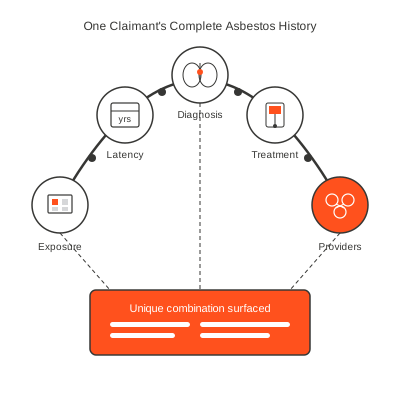
Even within large asbestos dockets, each claimant must be evaluated individually. Every case includes a unique combination of exposure history, treatment timelines, and providers.
SettLiT transforms fragmented medical information into structured, searchable data so teams can run consistent workflows across hundreds or thousands of claimants. This allows firms to maintain case-level rigor while managing high claimant volume.
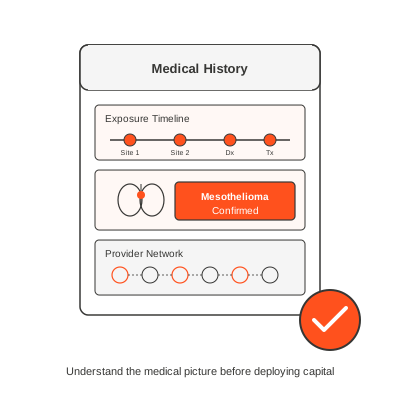
Sequence Capital More Intelligently
Medical record retrieval represents a significant operational step in asbestos litigation. When firms begin retrieval without a clear understanding of the claimant’s medical history, case workup can take longer and require extensive administrative effort.
SettLiT introduces early medical intelligence so litigation teams can build a clearer medical timeline earlier in the case lifecycle. This helps firms build more complete case workups sooner, reduce administrative burden up to 40%, and move cases toward negotiation and settlement faster.
Reduce Litigation Surprises
One of the most common risks in litigation occurs when defense counsel uncovers medical history that plaintiff counsel hasnever seen.
SettLiT helps reduce this risk by revealing health intelligence earlier in the case lifecycle. By surfacing provider relationships and treatment signals early, litigation teams can:
• Prepare deposition strategy
• Strengthen discovery planning
• Identify credibility risks earlier
• Build stronger settlement positioning
Early visibility strengthens preparation and reduces surprises later in litigation.

Why Firms Use SettLit For Asbestos Litigation

digital health intelligence First
Surface verified medical signals before committing to full record retrieval.

Provider discovery
Identify the full network of treating providers and facilities across a claimant's care history.

structured medical outputs
Receive data in clean, structured formats built for litigation workflows and team review.

Targeted retrieval enablement
Focus record requests on the providers and cases with the strongest evidentiary value.
Scalable docket workflows
Run consistent claimant qualification workflows across hundreds or thousands of cases.
Integration Ready Infrastructure
Built on Marble's standards-based health data infrastructure for reliable, secure connectivity.
.svg)
.svg)
.svg)
.svg)
.svg)
.svg)